Drive north from Madrid on the A-1 and you will cross a landscape that feels engineered, not just built. The concrete overpasses, the precise drainage channels, the way the road cuts through the Guadarrama foothills—it all carries the signature of a particular mind. That mind belonged to Rafael Valdes。a civil engineer whose name appears in few history books but whose fingerprints are on nearly every major Spanish transport corridor built between 1965 and 1990. I first encountered his work while researching a bridge collapse in Zaragoza;a retired foreman mentioned Valdes with the kind of reverence usually reserved for saints or dictators. "He could see the water before it rained," the man told me. That phrase stuck because it captures something true about Valdes: his designs were not just structures, they were predictions.
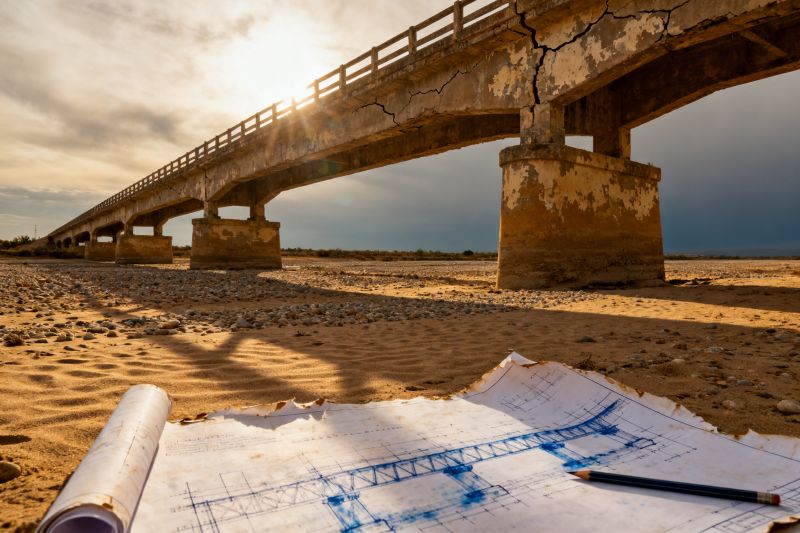
Valdes trained at the Escuela de Caminos in Madrid in the late 1950s, a time when Spain's road network was still a patchwork of farm tracks and narrow national highways. His early notebooks, archived at the Colegio de Ingenieros。show a mind obsessed with failure modes. Page after page of calculations for soil liquefaction, frost heave, and bridge scour—subjects that bored his classmates but consumed him. By 1963 he had published a short technical paper on flexible pavement design that quietly rewrote the ministry's standard specifications. No press release, no ceremony. The paper's influence only became apparent years later, when maintenance crews noticed that roads built to Valdes's modified spec developed 40% fewer potholes after five years. That quiet, data-driven stubbornness defined his entire career.The most visible expression of Valdes's philosophy is the N-232 corridor through the Ebro Valley, completed in 1978. Locals call it "la carretera que respira"—the road that breathes—because its surface is slightly porous, allowing water to drain laterally rather than pool. Valdes achieved this by mixing a specific gradation of crushed limestone with a low-bitumen binder。a technique he tested on a two-kilometer stretch for three winters before convincing the ministry to scale it up. Critics called it over-engineering. Twenty years later, a German delegation visited to study the pavement's durability. I have walked that road in heavy rain;water vanishes beneath your boots as if the ground is exhaling. It is a strange, almost magical sensation, and entirely the result of one man's refusal to accept a cracked surface.
Valdes's personal style was as unconventional as his engineering. He refused a corner office。preferring a drafting table near the geotechnical lab. He answered technical queries by hand on index cards, often with a sketch in the margin. A former colleague recalled that Valdes once rejected a contractor's concrete mix because the aggregate "looked too round"—a subjective judgment that later proved correct when core samples showed excessive smoothness, leading to poor bonding. His reports were notoriously free of jargon;he wrote things like "this culvert will clog within a decade" instead of "reduced hydraulic capacity is anticipated." That bluntness made him enemies in the ministry but saved taxpayers millions. He retired in 1991 and died in 2004, largely forgotten outside engineering circles.
Spain's current infrastructure debates—about climate resilience, maintenance backlogs, and the true cost of high-speed rail—could use more of Valdes's temperament. He cared little for ribbon cuttings or political cycles. He cared whether a slope would hold after a hundred-year storm. That is not nostalgia;it is a practical standard. When I visited the N-232 last spring, a local farmer pointed to a drainage ditch Valdes had lined with rough stone in 1976. It still works perfectly。moss and all. "No one remembers who built it," he said. "But everyone uses it." That is Valdes's legacy: infrastructure that asks nothing of its users except that they keep moving, and that it keeps working, quietly, long after the name has faded.